
 Ms. Lê Thị Ánh Trinh
“Farm to table” is a term that remains relatively unfamiliar to many people and has only begun to gain attention and application in recent years. As a result, the farm-to-table model has not yet been widely adopted. Therefore, this article aims to explain the concept while exploring GC Food’s story of applying this model to its production process.
1. The concept of “farm to table”
The “farm to table” model focuses on the natural cultivation and harvesting of agricultural products. These products are processed directly at the farm, while organic waste, such as spoiled vegetables, roots and unusable leaves, is collected and recycled as fertilizer for the next crop. This process helps form a closed-loop agricultural value chain.
When the farm-to-table model is combined with the 3F model (Feed, Farm and Food), it creates a fully integrated food production process that is closely monitored from cultivation and harvesting to processing and consumption.
The 3F model serves as a reassuring solution for consumers amid rising concerns about food safety and hygiene. This is because the entire process is strictly supervised, from breeding and farming stages to the final distribution of products. As a result, food products are produced within a comprehensive, safe and closed production environment.
2. Outstanding advantages
Below are the key advantages of the “farm to table” model:
Clear product origin: Products developed under this model have transparent and clearly traceable origins, making it easy for consumers to track sources and verify product information.
Closed-loop production process: Products are closely monitored from planting and breeding to harvesting, processing and distribution. As a result, substandard inputs are eliminated, ensuring high-quality final products.
Addressing long-standing challenges in the agricultural sector: Traditional agricultural practices involve multiple stages, each of which may present unresolved issues. When products fail to reach the market, accountability is often unclear. The application of the 3F model helps resolve this problem by ensuring that every stage of production is closely supervised and clearly assigned to a responsible entity.
3. GC Food’s journey in applying the farm to table model
GC Food is one of the pioneering companies to embrace the farm-to-table approach. Recognizing the benefits and potential of this model, GC Food has made significant investments and achieved notable success.
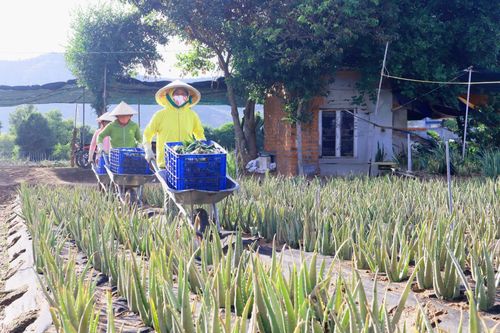
GC Food has collaborated with local farmers in the former Ninh Thuan province to cultivate aloe vera, as the region’s climate and soil conditions are well-suited for the growth of this crop. As a result, within a short period of time, the number of aloe vera farms in the former Ninh Thuan province increased significantly.
The partnership between GC Food and farmers in the former Ninh Thuan province has brought mutual benefits to both parties. Previously, aloe vera farmers in the region often faced concerns about market access. However, through collaboration with GC Food, aloe vera now enjoys a stable and reliable market. The application of the 3F model in the aloe vera cultivation process enables GC Food to secure a high-quality and consistent supply of raw materials for production.

4. Aloe vera production process at GC Food
In addition to procurement cooperation, GC Food also supplies F1 seedlings and provides cultivation guidance to farmers in the former Ninh Thuan province. GC Food then closely supervises the planting and care processes to ensure optimal aloe vera quality. After being harvested at the farms, aloe vera is transported to GC Food’s VietFarm factory for preliminary processing and further manufacturing.
Following multiple processing stages, the finished aloe vera products are preserved in accordance with strict standards. Finally, GC Food brings these aloe vera products to the market and delivers them to consumers.
GC Food maintains continuous involvement at every stage of the process, from cultivation to final delivery to customers. This comprehensive oversight ensures that each aloe vera product meets high-quality standards and is supported by numerous certifications that demonstrate GC Food’s credibility and reliability.
5. Applications of GC Food’s aloe vera
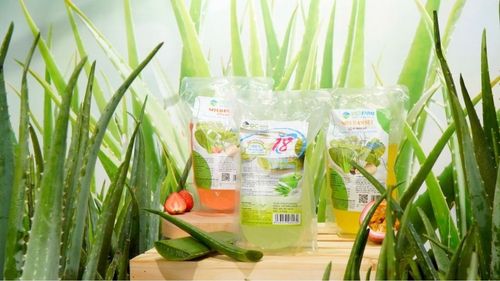
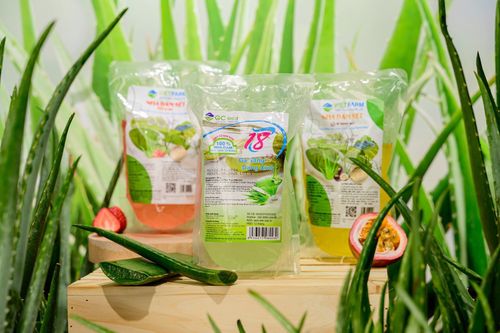
GC Food’s aloe vera products offer a wide variety of types and flavors, meeting diverse processing and usage needs.
Products such as Aloe Vera Cubes, Crispy Aloe Vera and Aloe Vera Blended With Sugar Water can be used in the preparation and mixing of a wide range of dishes and beverages.

GC Food’s aloe vera products not only meet the needs of individual consumers but also cater to businesses in the F&B sector, including restaurants and hotels.
The farm-to-table model is being increasingly adopted and widely implemented. With a strategic vision, GC Food recognized the promising future of this model and invested in its development. As a result, GC Food has secured a stable supply of high-quality raw materials while earning the trust of its customers. Moreover, GC Food takes pride in the fact that through this model, the company is able to support farmers in the former Ninh Thuan province in achieving stable livelihoods, while also delivering premium aloe vera products to consumers.
For more useful information, please visit the about us section.
This article was compiled by the GC Food Team - Expert in natural ingredients.